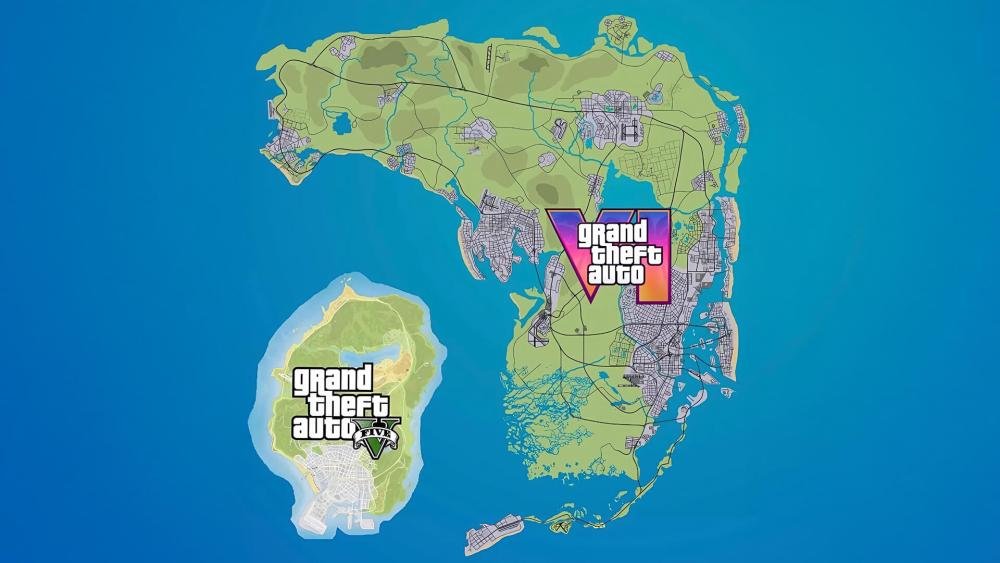
Rockstar Games has not published an official area or scale for Grand Theft Auto 6's world. Public discussion relies on trailer footage, community reconstructions and technical inference rather than any verified square-kilometer measurement.
The studio confirmed the setting returns to Vice City and suggested a larger, multi-region map. The game is scheduled for PlayStation and Xbox on November 19, 2026, with a later PC release, but Rockstar has not released definitive map metrics.
How fans and analysts try to estimate GTA 6's map size
Community researchers use several reproducible techniques to produce estimates. Common methods include measuring travel time between visible landmarks in trailers, scaling overhead map textures when available, and triangulating distances from multiple camera angles.
Other approaches rely on in-game telemetry when builds leak, reading coordinate systems from files, or stitching together screenshots to form a bounding box. Analysts also compare apparent landmark density to reference maps from previous Rockstar titles to infer relative scale.
Practical techniques: speed, pixels and photogrammetry
One practical workflow starts by establishing a reference: a vehicle or character with a known in-game speed. Observers time a traversal sequence, correct for camera cuts and speed modifiers, and convert elapsed time into distance under the assumed top speed.
Photogrammetry-style methods extract feature positions from multiple trailer frames, align them using camera parameters and estimate real-world distances in map units. Measuring the in-game minimap or HUD elements in pixels also lets modders derive a pixel-to-world conversion when a reliable scale factor exists.
Why trailer-based and visual estimates can be misleading
Trailers are edited, use cinematic camera rigs, and often include scripted vehicle behavior. Field of view, lens distortion and post-processing complicate direct distance measurement. Time dilation and sped-up sequences further distort traversal times.
Separately, a large amount of apparent geography can be non-playable or reserved for streaming and background scenery. Interiors, instanced areas and vertical layering mean raw surface area does not equal playable space or missionable terrain.
Engine and platform factors that affect perceived map scale
Map size interacts with streaming architecture, memory budgets and draw distance settings. A technically larger world can be achieved by aggressive streaming of tiles and lower asset density per tile, while a smaller, denser map produces the same perceived scope with less raw area.
Platform targets shape choices: console memory limits, CPU threading and IO throughput constrain how much seamless geography can be active at once. Those constraints influence design trade-offs between open vistas, dense POI counts and long uninterrupted drives.
What a verified measurement would change for players and developers
An official square-kilometer figure would let analysts calibrate traversal estimates, tune vehicle balancing assumptions and compare content density against past Rockstar releases. It would also clarify technical expectations for streaming, LOD regimes and platform-specific optimizations.
Until Rockstar publishes precise metrics, technical discussions should treat numeric claims as provisional, emphasize the estimation method used and highlight which parts of the world are playable versus background scenery.
In short, several mature, repeatable techniques exist to approximate GTA 6's map, but each carries systematic errors tied to trailers, editing and engine behavior. A confirmed measurement from Rockstar remains the only way to resolve those uncertainties.