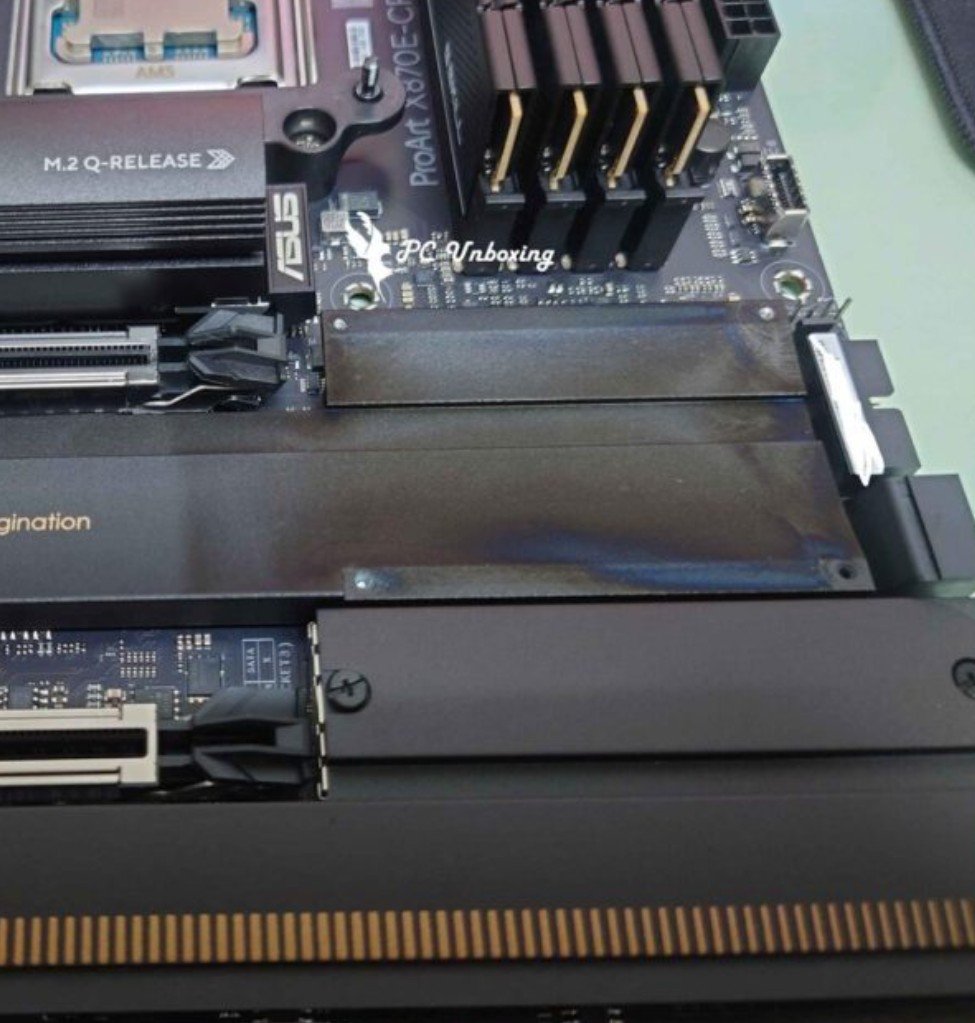
A user report published on a Taiwanese forum and relayed by tech sites describes visible discoloration on the PCH heatsink of an ASUS ProArt X870E-Creator WiFi motherboard after about six months with an ASUS ROG Astral GeForce RTX 5090 installed.
The card was reportedly mounted in a system using an ASUS ProArt PA602 case. After removal, the motherboard’s chipset heatsink showed marks the poster described as heat discoloration; part of the stain came off with a damp cloth, but the heatsink did not fully return to its original appearance. The graphics card itself reportedly continued to function normally.
Technical context for the ROG Astral RTX 5090 and ProArt X870E
The ROG Astral GeForce RTX 5090 OC Edition is a very large custom model built for high thermal loads. ASUS lists the card with 32 GB GDDR7, 21,760 CUDA cores, a 512-bit memory bus, PCIe 5.0 and boost clocks around 2,580–2,610 MHz depending on mode. Its massive cooler can alter local airflow in tightly packed systems.
The ProArt X870E-Creator WiFi is a high-end X870E motherboard for creator systems with PCIe 5.0, DDR5 support, USB4, 10 Gb and 2.5 Gb LAN and multiple M.2 slots. On that board the chipset heatsink sits below or near where large GPUs are commonly installed, so changes in local airflow or heat exposure are plausible when a big GPU is present.
Why the marks do not prove a design or safety fault
Crucially, this report is a single user account and is not an official confirmation by ASUS. No manufacturer statement, thermal measurements, material analysis, or lab testing has been published to link the discoloration definitively to the GPU’s heat output.
Other explanations remain possible, including light exposure, material aging, dust or residue, cleaning agents, or an optical surface change rather than thermal damage. The fact that the GPU continued operating normally further argues against an immediate functional failure in this instance.
Practical advice for owners of large RTX 5090 custom cards
Even if the cause is unproven, the case highlights practical checks owners of large, high-end graphics cards should perform: ensure unobstructed airflow under and around the GPU, adequate case exhaust, tidy cable routing and, where relevant, mechanical support for heavy cards to avoid undue stress.
The report does not justify a blanket warning against the ROG Astral RTX 5090 or the ProArt X870E-Creator WiFi; it remains an isolated, not generally confirmed finding that merits caution and monitoring rather than definitive conclusions.
The community discussion and linked coverage surfaced the issue, but without temperature logs or lab analysis the root cause stays speculative.