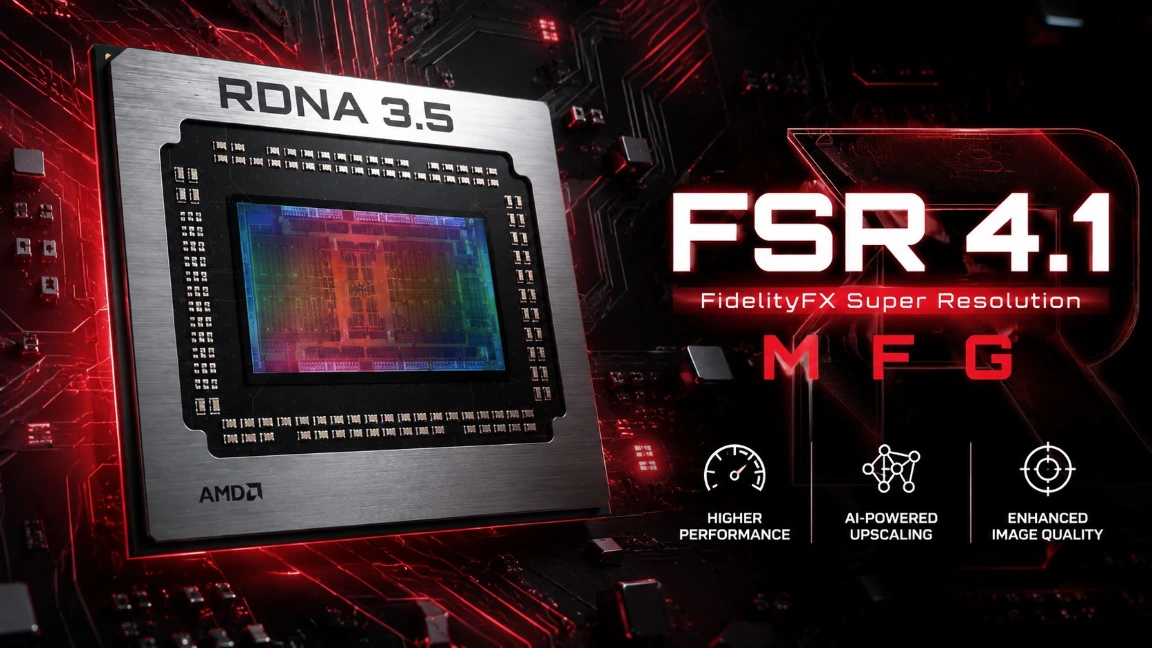
An early build of FSR 4.1.1 containing an INT8 model briefly appeared in Valve's Proton Experimental depot and, according to a Reddit user who downloaded the file, the leaked version can be used with RDNA 3.5-based graphics as well as RDNA 2 and RDNA 3 GPUs.
The file identified as amdxcffx64.dll was reportedly signed, so it could be dropped into PC tools to enable the new FSR model. The user tested the DLL with OptiScaler and found the INT8 build worked on an RX 7800 XT (RDNA 3) and even allowed an RX 6900 XT (RDNA 2) to run the model, though artifacts were reported on the older GPU.
What the leak shows about FSR 4.1.1 and INT8
The leaked amdxcffx64.dll appears to contain an INT8 variant of the FSR 4.1 model. According to the report, adding the DLL next to OptiScaler and updating the amd_fidelityfx_upscaler_dx12.dll, then enabling FSR4Update in OptiScaler.ini, brings FSR 4.1 functionality to previous-generation Radeon cards.
Visual issues on RDNA 2 hardware were noted by the tester, suggesting AMD's official optimizations for older GPUs are still required to avoid artifacts.
RDNA 3.5 iGPUs appear compatible
Notably, the leaked INT8 model reportedly ran without problems on the Radeon 890M iGPU, a part of high-end Strix Point APUs that use RDNA 3.5. That result is relevant because AMD's public messaging has focused on RDNA 2 and RDNA 3 support for FSR 4.1, while information about RDNA 3.5 compatibility has been less clear.
If official support arrives, it would matter to Zen 5-based APUs that rely on RDNA 3.5 graphics, potentially bringing the new upscaling model to those platforms.
Why this matters for PC upscaling and APUs
FSR 4.1 with an INT8 model could lower runtime costs for upscaling on supported hardware and broaden the range of GPUs that can use AMD's latest fidelity model. For APUs, working INT8 support on RDNA 3.5 iGPUs would be significant because many future mobile and small-form-factor systems depend on those integrated GPUs.
However, the leak also highlights that unofficial builds can behave differently across architectures and that AMD's optimized releases remain important for stability and visual quality.
The build was pulled from Proton Experimental shortly after Valve uploaded it, but a user downloaded it in time and documented the tests on Reddit. The original report and the related Proton depot activity are the primary sources for this story.